

When learning English, understanding how verbs change form can be one of the trickiest parts. One common verb that learners often struggle with is “speak.” Knowing how to use this verb in the past tense correctly can significantly improve your grammar and confidence in communication. Whether you’re writing an email, having a conversation, or narrating a story, mastering the past tense of “speak” is essential for clear and accurate expression.
What is the Past Tense of “Speak”?

The past tense of “speak” is “spoke.” This might seem straightforward, but because “speak” is an irregular verb, it doesn’t follow the usual -ed rule like regular verbs (e.g., “talk” becomes “talked”). Instead, it changes form entirely.
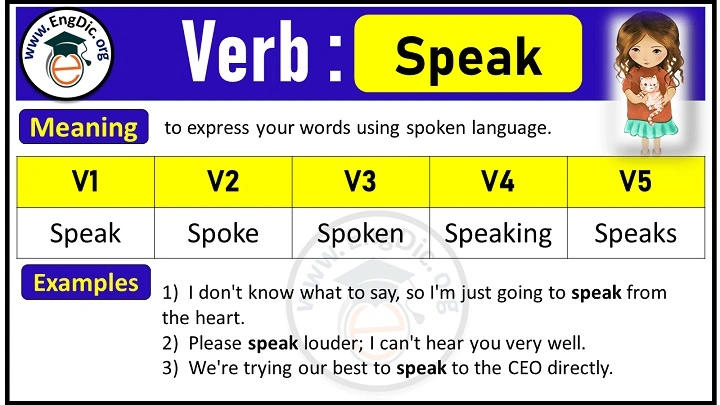
| Base Form | Past Simple | Past Participle |
| speak | spoke | spoken |
Understanding this table is essential for using the verb correctly in various tenses.
When to Use “Spoke”
Use “spoke” when you are talking about a completed action that happened in the past. Here are some examples:
- I spoke to my manager yesterday.
- She spoke at the conference last week.
- They spoke about the issue during the meeting.
The key here is that the action is finished and took place in the past. There are no ongoing or future implications in these sentences.
Common Mistakes to Avoid
Using “spoken” instead of “spoke” in simple past
Incorrect: He spoken to me about it yesterday.
Correct: He spoke to me about it yesterday.
“Spoken” is the past participle, which is only used with helping verbs like “has,” “have,” or “had.”
Forgetting to change the verb at all
Incorrect: Yesterday I speak to my teacher.
Correct: Yesterday I spoke to my teacher.
Many English learners accidentally use the base form when they should use the past tense. Always remember to change the verb when describing a past event.
Difference Between “Spoke” and “Spoken”
This is a major point of confusion. Let’s clear it up.
- Spoke is used on its own in simple past sentences:
I spoke to her last night. - Spoken is used in perfect tenses and always with a helping verb:
I have spoken to her already.
She had spoken to him before the meeting.
They have spoken many times before.
You can’t say: I spoken to her last night. That would be grammatically incorrect unless used with a helping verb.
Tenses and Sentence Examples
Here’s how “speak” changes in different tenses:
Present Simple
- I speak English.
- He speaks very clearly.
Past Simple
- I spoke with him yesterday.
Present Perfect
- I have spoken to the manager.
Past Perfect
- She had spoken to the client before the meeting.
Future Perfect
- By tomorrow, we will have spoken to all the team members.
Idioms and Phrases Using “Spoke”
Here are some common phrases you might encounter:
- Spoke too soon – Said something before knowing all the facts
I thought I passed the test, but I spoke too soon. - Spoke out – Voiced an opinion, especially against something
She spoke out against injustice. - Spoke up – Raised one’s voice or opinion
He finally spoke up during the meeting.
These phrases also use the past tense of “speak,” so it’s helpful to understand how the verb functions in different contexts.
Tips for Mastering Irregular Verbs Like “Speak”

- Make flashcards: Write down the base form, past tense, and past participle on a card. Quiz yourself regularly.
- Group similar verbs: Learn verbs in groups to see patterns (e.g., speak/spoke/spoken, write/wrote/written).
- Use them in sentences: Practice makes perfect. Try writing a short paragraph using the word “spoke.”
- Listen to native speakers: Watch English shows or podcasts. Notice how and when “spoke” and “spoken” are used.
Practice Exercise
Try filling in the blanks with the correct form of “speak.”
- Yesterday, I _____ to the director about the proposal.
- She has _____ about this issue many times.
- We _____ for hours last night.
- They had already _____ to the witness before we arrived.
Answers:
- spoke
- spoken
- spoke
- spoken
Using “speak” in the past tense is not as difficult as it seems once you understand the rules and practice a bit. The key takeaway is to remember that “spoke” is used in the simple past, while “spoken” is used with helping verbs in perfect tenses. With regular use and attention to detail, you’ll find that mastering irregular verbs like “speak” becomes second nature.
So the next time someone asks you, “Have you spoken to him yet?” — you’ll know exactly what they mean and how to answer with confidence.