


The present indefinite tense in Hindi is one of the most commonly used tenses, particularly for expressing regular actions, facts, habits, and universal truths. This article will explain the structure, usage, and provide examples of sentences in present indefinite tense in Hindi, ensuring you have a solid understanding of its application.
What is Present Indefinite Tense in Hindi?

The present indefinite tense in Hindi refers to actions or situations that are habitual, routine, or facts that are true in the present. It is equivalent to the simple present tense in English. This tense is used to express things like:
- Habitual actions (something you do regularly)
- General truths (facts that are universally true)
- Permanent situations (ongoing states)
- Instructions and directions
The formula for the present indefinite tense in Hindi follows the structure:
Subject + Verb (root) + “ता/ती/ते” (depending on the subject) + Object.
In this structure:
- The verb is conjugated according to the subject’s gender (masculine/feminine) and number (singular/plural).
- “ता” is used with masculine singular subjects.
- “ती” is used with feminine singular subjects.
- “ते” is used with masculine plural subjects.
- “तीं” is used with feminine plural subjects.
Conjugation Examples
- मैं (I): करता हूँ (kar-ta hoon)
- तुम (You): करते हो (kar-te ho)
- वह (He/She): करता है / करती है (kar-ta hai / kar-tee hai)
- हम (We): करते हैं (kar-te hain)
- वे (They): करते हैं (kar-te hain)
Structure of Present Indefinite Tense in Hindi
Affirmative Sentences
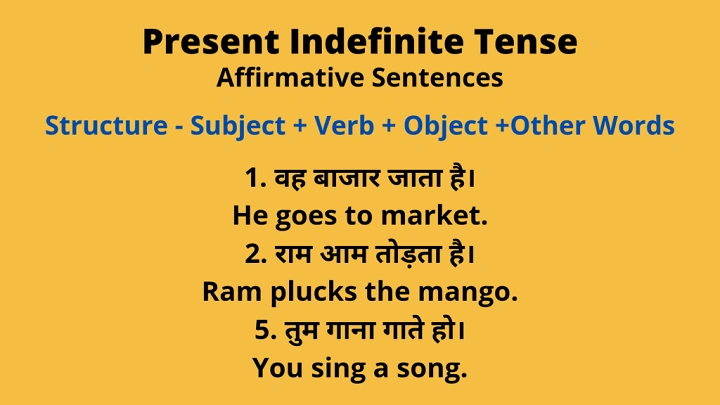
In affirmative sentences, the verb is conjugated based on the subject’s gender and number. The general structure is:
- Subject + Verb + Object
- Example 1: मैं हिंदी बोलता हूँ (I speak Hindi).
- Example 2: वह स्कूल जाता है (He goes to school).
Negative Sentences
For negative sentences in the present indefinite tense, the word “नहीं” (no/not) is added after the verb.
- Subject + Verb + नहीं + Object
- Example 1: मैं स्कूल नहीं जाता हूँ (I do not go to school).
- Example 2: तुम अच्छा नहीं पढ़ते हो (You do not study well).
Interrogative Sentences
In interrogative sentences, “क्या” (what) is placed at the beginning of the sentence, followed by the subject and verb.
- क्या + Subject + Verb + Object?
- Example 1: क्या तुम स्कूल जाते हो? (Do you go to school?)
- Example 2: क्या वह किताब पढ़ता है? (Does he read a book?)
Usage of Present Indefinite Tense in Hindi
To Express Routine or Habitual Actions
The present indefinite tense is used to express actions that are performed regularly or as a habit. These actions are repeated over time.
- मैं रोज़ दौड़ता हूँ (I run every day).
- वह हर सप्ताह स्कूल जाता है (He goes to school every week).
To Express General Truths or Facts
The present indefinite tense is used to state facts or universal truths that are always true.
- पानी उबालने पर उबालता है (Water boils when heated).
- सूरज पूर्व से उगता है (The sun rises in the east).
To Express Ongoing or Permanent States
This tense is also used to describe situations or states that are permanent or ongoing.
- वह डॉक्टर है (He is a doctor).
- यह शहर बहुत सुंदर है (This city is very beautiful).
To Give Instructions or Commands
Present indefinite tense is used to issue commands or provide instructions.
- दरवाजा बंद करो (Close the door).
- ध्यान से सुनो (Listen carefully).
Examples of Present Indefinite Tense in Hindi

Here are some more examples of the present indefinite tense in Hindi:
Positive Sentences:
- मैं किताबें पढ़ता हूँ (I read books).
- तुम मुझसे मिलते हो (You meet me).
- वह गाना गाता है (He sings a song).
- हम हर दिन योग करते हैं (We do yoga every day).
- वे क्रिकेट खेलते हैं (They play cricket).
Negative Sentences:
- मैं क्रिकेट नहीं खेलता हूँ (I do not play cricket).
- तुम मुझसे नहीं मिलते हो (You do not meet me).
- वह किताबें नहीं पढ़ता है (He does not read books).
- हम सुबह-सुबह नहीं दौड़ते हैं (We do not run early in the morning).
- वे यहाँ नहीं रहते हैं (They do not live here).
Interrogative Sentences:
- क्या तुम मुझसे बात करते हो? (Do you talk to me?)
- क्या वह गाना गाता है? (Does he sing a song?)
- क्या हम वहाँ जा रहे हैं? (Are we going there?)
- क्या तुम हर दिन स्कूल जाते हो? (Do you go to school every day?)
- क्या वे पार्क में खेलते हैं? (Do they play in the park?)
Common Mistakes in Present Indefinite Tense
When learning the present indefinite tense in Hindi, people often make a few common mistakes, such as:
Misuse of Verb Forms:
It’s crucial to use the correct form of the verb according to the subject’s gender and number. For example:
- Incorrect: वह किताब पढ़ते हैं (He read books).
- Correct: वह किताब पढ़ता है (He reads books).
Omission of “नहीं” in Negative Sentences:
Sometimes, the negative “नहीं” is missed in negative sentences.
- Incorrect: मैं स्कूल जाता हूँ (I school go).
- Correct: मैं स्कूल नहीं जाता हूँ (I do not go to school).
FAQs about Present Indefinite Tense in Hindi
What is the use of present indefinite tense?
The present indefinite tense is used to describe habitual actions, general truths, facts, and permanent situations in the present.
How do we form negative sentences in present indefinite tense?
To form negative sentences, add “नहीं“ (no) after the verb in the sentence.
What are examples of present indefinite tense?
Examples: मैं रोज़ पढ़ता हूँ (I read every day), तुम खाना बनाते हो (You cook food).
How does present indefinite tense differ from present continuous tense?
The present indefinite tense refers to habitual or general actions, while the present continuous tense refers to actions happening at the moment of speaking.
Can present indefinite tense be used for instructions?
Yes, present indefinite tense is often used to give commands or instructions.
The present indefinite tense in Hindi is an essential part of communication as it helps to express actions that happen regularly, general facts, and permanent situations. By understanding its structure and usage, you can enhance your command over the language and converse more naturally in various scenarios.