

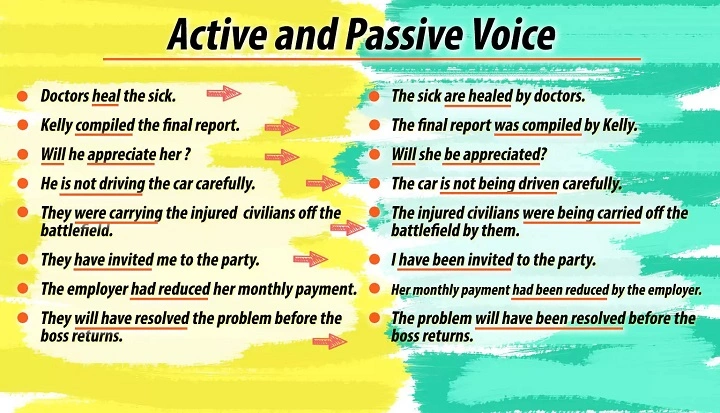
English grammar can be intimidating sometimes. But certain things can be learned. If you practice them for a specified period of time. Active and passive voice is one very significant aspect of grammar. Both these methods of expressing the same thing can also alter the tone of your sentence.
The good news is, if you are aware of the rule, these sentences are extremely easy to learn. Here, 50 active and passive voice sentence examples are provided in an easy manner. They will help you in speaking, exams, or even writing formal matters.
What is Active Voice?
It is when the subject is doing the action. The doer of the action is called the subject.
Example:
Active: The teacher teaches the lesson.
Here, the teacher is the subject. He is doing the action.
What is Passive Voice?
Passive voice is when the subject is having something done to them. The doer is not highlighted here. Rather, the action and object are highlighted.
Example:
Passive: The lesson was explained by the teacher.
Here the emphasis is laid on the lesson. It is not on the teacher.
Rules to Remember
Active: Subject + Verb + Object
Passive: Object + To be verb + Past participle + By + Subject
Not all sentences can be converted into passive. Passive is utilized in formal writing or if doer is unimportant.
50 Active and Passive Voice Sentence Examples
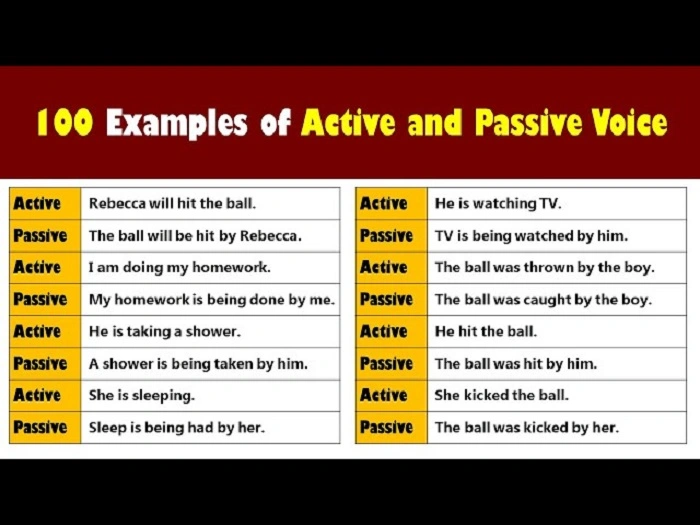
Sentences in Present Simple
Active: She writes a letter.
Passive: A letter is being written by her.
Active: They play cricket.
Passive: Cricket is played by them.
Active: The children eat mangoes.
Passive: Mangoes are being eaten by the children.
Active: They built a house.
Passive: A house was built by them.
Sentences in Future Simple
Active: She will purchase a pen.
Passive: A pen will be purchased by her.
Active: They will play football.
Passive: Football will be played by them.
Active: We are giving the party.
Passive: The party is being given by us.
Sentences in Present Continuous
Active: She is writing a letter.
Passive: A letter is being written by her.
Sentences in Past Continuous
Active: She was cooking.
Passive: She was being cooked by her.
Active: They were playing soccer.
Passive: Soccer was being played by them.
Active: We were watching a match.
Passive: A match was being watched by us.
Sentences in Present Perfect
Active: They had done the work.
Passive: The work had been done by them.
Active: He had fixed the fan.
Passive: The fan had been fixed by him.
Active: We had seen the movie.
Passive: The movie had been seen by us.
Sentences in Future Perfect
Active: She will have finished the project.
Passive: The project will have been finished by her.
Active: They will have cleaned the park.
Passive: The park will have been cleaned by them.
Active: He will have written the book.
Passive: The book will have been written by him.
Active: I shall have painted the wall.
Passive: The wall shall have been painted by me.
Active: We shall have solved the problem.
Passive: The problem will be solved by us.
Sentences with Modals
Active: She can speak French.
Passive: French can be spoken by her.
Active: They need to do the work.
Passive: The work needs to be done by them.
Active: He ought to write the essay.
Passive: The essay ought to be written by him.
Active: I can purchase a new phone.
Passive: A new phone can be purchased by me.
Why Learn Voice?
Active voice is direct, strong, and straightforward. We all use it daily. We speak, narrate, and write in it. Passive voice is useful. If you’re emphasizing the action. Or the doer is unknown or irrelevant.
There is more emphasis on the thief in passive. Whereas the doer is emphasized in the person who arrested him.
Also Read: English Books to Read to Improve English: Your Ultimate Guide to Language Fluency
Common Mistakes to Be Evaded
All students confuse active and passive voices when they cannot identify the subject and the object correctly. One of the most common mistakes is using the wrong form of tense. Another mistake is trying to impose the passive voice where it doesn’t belong. Hence the sentence seems awkward. Always remember that passive should be used only if it has a specific purpose.
Importance in Exams and Writing
Active and passive voice questions are the darling of English exams because they test your control over sentence structure and the use of verbs. In essays, letters, and reports, using the correct form of voice can also affect your grades. Both voices will also be used by you in life based on whether the doer or the action needs to be stressed. For example, in reporting the news, passive voice will be used most of the time because the action is more important than the doer.
Practice Every Day
Practice is the best way to master active and passive voice. Take five sentences each day. Try to rewrite both of the forms. Read children’s storybooks, newspapers, or even advertisements. Then try to locate sentences that are written in a passive voice. With time, you will start developing patterns and changing them will become second nature. By frequent usage, these sentences will no longer appear as rules of grammar and will rather be a part of your natural speech.
Tips to Master Active and Passive Voice
- Find the subject and object before the conversion.
- Use the correct verb form.
- Practice tense change.
- Read the daily newspaper and observe how passive is applied in bulk.
- Try writing a paragraph in active and then try converting it into passive.
FAQs
Which one is preferable to use?
Active voice is preferable to use in general. But passive voice proves to be handy. While writing in formal situations or when the doer is irrelevant.
Can all sentences be transformed into passive voice?
No. Only transitive verbs (verbs that have an object) can be transformed into passive voice.
Why do they always include active and passive voice questions in tests?
Because not only is it testing your grammar ability but also how you are able to use different sentence structures.
How can I get more practice?
Choose easy active sentences from a book or your surroundings and try writing their passives.
Last Thoughts
It will feel like learning one more rule of grammar to master it at the beginning. But once you have practiced, it is simple. The first one helps you write and speak with power and clarity. The second one contributes to flexibility.
This is only the beginning. If you practice speaking a few sentences a day. And listen to English readings, and notice how it is used around you. Then you will be switching between the two forms unconsciously.
Remember, grammar doesn’t have rules. It’s just about saying things clearly. So, use these examples, and practice every day. They will no longer be an issue. But rather they will be a powerful tool to use when studying English.