


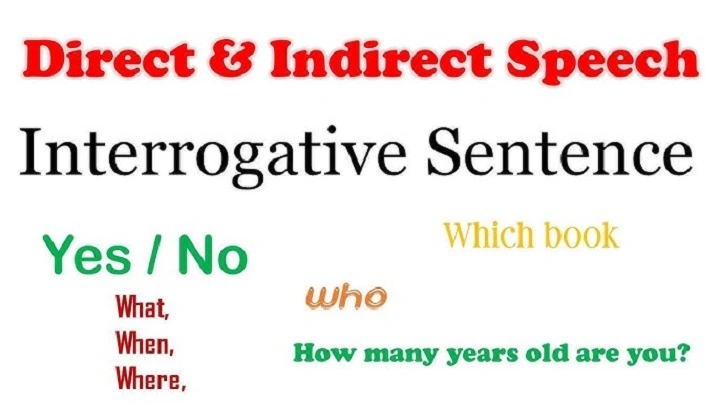
Interrogative sentences are sentences that ask a question. Unlike declarative sentences that state a fact or exclamatory sentences that show strong emotions, interrogative sentences seek information. They always end with a question mark (?) when written.
In English grammar, interrogative sentences can be direct or indirect. Understanding the distinction between them can help you communicate more effectively, whether you are speaking casually, writing formally, or delivering a presentation.
Let’s explore each type in detail, with examples to make things even clearer.
Direct Interrogative Sentences

A direct interrogative sentence asks a question straightforwardly. It is easy to spot because it usually starts with a helping verb (like do, does, is, are, can) or a question word (like what, where, why, who, when, how) and ends with a question mark.
Structure of Direct Interrogative Sentences
The basic structure usually follows:
- Helping verb/Question word + Subject + Main verb + (Object/Complement)?
For example:
- Are you coming to the party?
- What time does the meeting start?
- Can she drive a manual car?
These sentences seek an immediate answer and are clear and to the point.
Types of Direct Interrogative Sentences
Direct questions can be divided into two categories:
- Yes/No Questions:
These questions expect a simple “yes” or “no” as the answer.
Examples:
- Did you complete your homework?
- Is it raining outside?
- Wh- Questions:
These questions seek specific information rather than a “yes” or “no” response.
Examples:
- Where do you live?
- How did you solve this problem?
Features of Direct Interrogative Sentences
- They always end with a question mark.
- They are direct and explicit.
- The word order usually inverts the subject and the verb (unlike in statements).
- Intonation typically rises at the end in spoken English.
Indirect Interrogative Sentences
An indirect interrogative sentence does not ask a question directly. Instead, it embeds a question inside another sentence or statement. In written form, it usually ends with a period (.) rather than a question mark.
Structure of Indirect Interrogative Sentences
The structure often looks like:
- Introductory phrase + Question word + Subject + Verb.
Notice that the word order stays the same as in a statement (Subject + Verb), unlike direct questions.
Examples:
- I wonder if you are coming to the party.
- Can you tell me what time the meeting starts?
- She asked whether he could drive a manual car.
Common Introductory Phrases for Indirect Questions
Indirect interrogative sentences usually start with phrases like:
- I wonder
- Could you tell me
- Do you know
- I’d like to know
- He asked
- She inquired
These phrases make the tone more polite, formal, or indirect, which is often preferred in professional or sensitive situations.
Examples of Direct vs Indirect Questions
| Direct Interrogative Sentence | Indirect Interrogative Sentence |
| Where is the nearest station? | Can you tell me where the nearest station is? |
| Did she call you yesterday? | I wonder if she called you yesterday. |
| What is your name? | Could you tell me what your name is? |
Features of Indirect Interrogative Sentences
- They often end with a period, not a question mark.
- The sentence structure is more like a statement.
- They sound more polite and formal.
- No subject-verb inversion happens after the introductory phrase.
How to Convert a Direct Question into an Indirect Question

Understanding how to transform direct questions into indirect ones can be very helpful, especially for writing formal emails or having diplomatic conversations.
Here’s a step-by-step guide:
- Choose an introductory phrase:
Start with something like “Can you tell me,” “I wonder,” or “Do you know.” - Keep the question word (if any):
If the direct question uses a wh- word, keep it. If not, use if or whether. - Change the word order:
The word order should follow the statement pattern (Subject + Verb). - Remove the question mark:
Indirect questions end with a full stop.
Example Transformation:
Direct: “Where is the library?”
Indirect: “Could you tell me where the library is.”
Direct: “Did he arrive on time?”
Indirect: “I wonder if he arrived on time.”
Why Understanding These Differences Matters
Knowing how to use direct and indirect interrogative sentences helps you adjust your tone according to the situation.
- In casual conversations: Direct questions are natural and expected.
- In professional or formal writing: Indirect questions are often more appropriate.
- In sensitive discussions: Indirect questions sound less aggressive and more polite.
Mastering this skill will not only make your English more fluent but will also help you sound more considerate, especially in business, academic, or international communication.
Quick Tips to Remember
- Use direct interrogative sentences when you want a clear and quick response.
- Use indirect interrogative sentences when you want to sound polite, formal, or diplomatic.
- Always adjust your tone based on the context and audience.
- Remember that indirect questions still ask for information but do so embedded within a statement or another question.
Direct and indirect interrogative sentences are crucial parts of English grammar and communication. While direct questions are straightforward and easy to spot, indirect questions offer a more nuanced, polite way of seeking information. By mastering both forms, you’ll improve not just your grammar skills but also your ability to communicate effectively across different situations and audiences.