


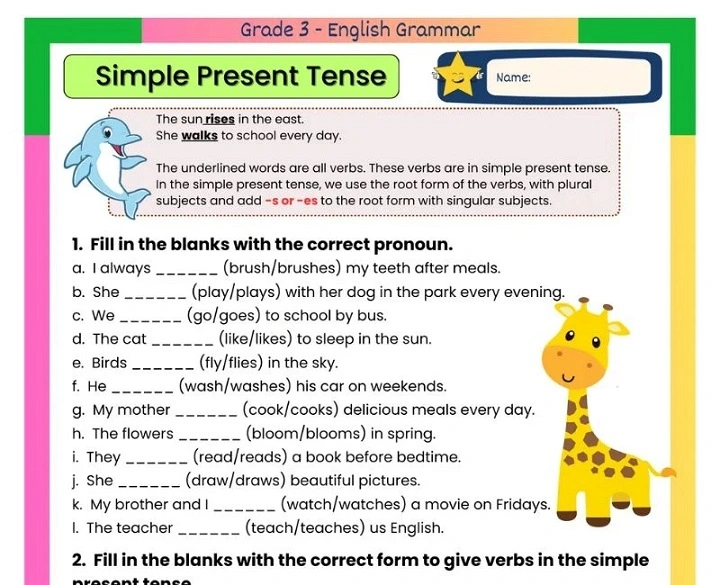
Present tense is the pillar of grammar. It renders you proficient in talking. You use present tense when you say things like “I go to school,” or “She is reading.” It being known, makes you proficient in converse regarding your daily work and daily routines with ease.
The present tense grounds your English in basic and uncomplicated ways. The present tense also provides you with a way of expressing your concepts in basic words. All four forms of this tense are covered here.
What Is the Present Tense
Present tense is used to describe that which already is in the process of occurring, habitual action, or that which always does. Present tense is also used to describe something which started before and goes on up to the present. For example, “I eat breakfast at eight,” “He plays football,” and “We have been working since morning.” All the sentences utilize something that already occurs.
There are four forms of the present tense. There are four: Present Indefinite Tense, Present Continuous Tense, Present Perfect Tense, and Present Perfect Continuous Tense.
Present Indefinite Tense

It is used to talk about habit, routine, and fact. We use it when there is something which always happens or something which always happens. Grammar is easy. Just Subject, add verb, add object. If the subject is singular we add s or es to the verb.
To make a negative sentence, insert do not or does not in front of the verb. To form a question, place do or does before it.
Employ everyday, always, generally, often, and sometimes with this tense.
Present Continuous Tense
This tense tells us about things done in the passage of time or temporary things done. Pattern is Subject and am, is, or are and the verb and ing.
Examples: I am reading. She is cooking. They are studying. We are talking. He is playing cricket.
The negative sentences have am not, is not, or are not before the verb. For example, I am not sleeping. She is not watching TV.
To form a question, put am, is, or are before it.
Present Perfect Tense
This tense is applied to describe an action taken previously but still accurate until the current time. This is a form made up of Subject with has or have and a verb as a past participle.
Examples: I have finished homework. She has attended school. They have been to the park. We have watched that movie.
To make negative sentences, put not or have not in front of the verb.
To make questions, begin with has or have. Have you completed your homework? Has he called you?
Most usual time words are already, yet, just, ever, never, and recently.
Examples and Common Errors
Pupils might be informed by instructors that “I finish work” is incorrect but “I have finished work” is because it has present and past.
The students can also construct sentences regarding their week. Like “I have cleaned my room,” “I have read two books,” or “I have called my friend.”
Present Perfect Continuous Tense
This tense indicates activity started in the past and ongoing until the present. The structure is Subject + has or have + been + verb + ing + since or for + time.
To create the negative, use have not or have not been. For example: I have not slept. She has not worked.
To create questions, use has or have and put in been. For example: Have you studied long? Has she lived here since childhood?
Time Words Practice
Time words used here are recently, since, and lately. The teachers can hold a place on a time chart and mark examples like since 6 a.m. or for two hours. Now, ask the students to provide examples like “I have been studying since morning.”
They can use five sentences on the basis of since and for. For example: I waited since 8 a.m. I have worked for two hours. They may ask an individual a question such as “How long have you been studying English?”
How to Identify Present Tense
Present simple can be directly determined from helping verbs and verb ending. If the verb is in base form, then it will be simple present. If ing comes after it, then it will be continuous. If has or have past participle comes after it, then it will be perfect. If has or have been ing comes after it, then it will be perfect continuous.
Worksheet
Convert into questions.
You speak English well.
She is delivering a lecture.
They have written the letter.
We have waited since morning.
Answers: Do you speak English well? Is she delivering a lecture? Have they written the letter? Have we waited since morning?
Common Mistakes
Common mistakes of present tense have to be corrected. “He go to school” instead of “He goes to school” is uttered by people. “She do not like tea” instead of “She does not like tea” is uttered by people. “I am eat food” instead of “I am eating food” is uttered by some. “He have finished his work” instead of “He has finished his work” is uttered by some. Teachers need to rectify such errors day by day so that one picks up a good habit.
Classroom Activities
The teachers can help the students repeat speaking and writing in such a manner that students pick them up conveniently. In a role play exercise, a student takes turns asking questions using present tense and the other one answers them. For instance: What do you do every morning? I brush my teeth and go to school.
There is one more activity, which is describing pictures. The teacher displays a picture of some individuals doing something and students inform them what they can see.
Practice Schedule on Daily Basis

A tense can be practiced daily by students to develop good grammar. Ten sentences can be written, read aloud, and tried to be applied in everyday usage. Reading one paragraph of English chunk by chunk and noting verbs also holds good. Then re-construction in another tense is logical.
Sample sentence: “I live in Dhaka. I have an office. I am studying English now. I finished studying and am improving my skill.” The students can underline the verbs and identify the tenses.
Also Read: Go Past Tense: Rules, Meaning, and Simple Examples for Students
Changing Tenses
The base verb is used in Simple present. For example: I read books.
Am, is, or are is put in front of the verb followed by ing in Present continuous. For example: I am reading books.
Has or have is put in front of past participles in Present perfect. For example: I have read books.
Present perfect continuous has been employed with verb + ing and temporal reference. It is the same as above: I have been reading since morning.
Why Worksheets Are Important
Practice is the best method of learning grammar. Worksheets allow you to enjoy the rhythm and meaning of sentences. Worksheets allow you to see your mistakes and correct them in seconds. Teachers like worksheets because they know how much the students have learned from the lesson in seconds. Students enjoy learning grammar with worksheets because it is simple and fun.
You can complete a worksheet a day so that you are thoroughly familiar with grammar rules. The practices become second nature when you write and talk. You start writing and speaking at a slow rate without giving much attention to rules.
Extra Practice Ideas
Make ten sentences using each of the present tense forms. Repeat them twice verbally. Read English music or news and try to find examples of present tense verbs. Explain your routines with friends throughout the day using simple present tense.
They can then have a mini competition where they tell their daily routine in all four present tense forms.
Mini exercises become enjoyable to learn and lead to memorization of what is learned.
Teachers’ Tips
Begin always with near-student examples. Utilize pictures and gestures. Drill and repeat short sentences daily. Correct respectfully and clearly. Make constant practice in speaking as tenses are learned more easily with real communication.
Practice writing short sentences. Attempting to communicate with friends in English. Watch short English videos and repeat out the sentences. Make your own examples every day. Maintain a small book of grammar and write ten new sentences every day.
Present tense is the foundation and most fundamental of English grammar. By learning it, you will be empowered to describe suitably your occupation, habit, and lifestyle. If you understand it, you will feel free to speak confidently.
Practice any one of them every day. Read aloud, write exercises and stories. You will find that you are constructing good sentences within a couple of weeks. Grammar isn’t difficult if practiced regularly. Present tense is where you start learning English communication.