

Introduction
In today’s competitive landscape, product development cycles are compressed to their limits. Traditional prototyping methods often lead to test failures due to insufficient strength or precision deviations, causing significant project delays. While technologies like 3D printing offer speed, they are frequently constrained by material performance, making it difficult to simulate real-world conditions.
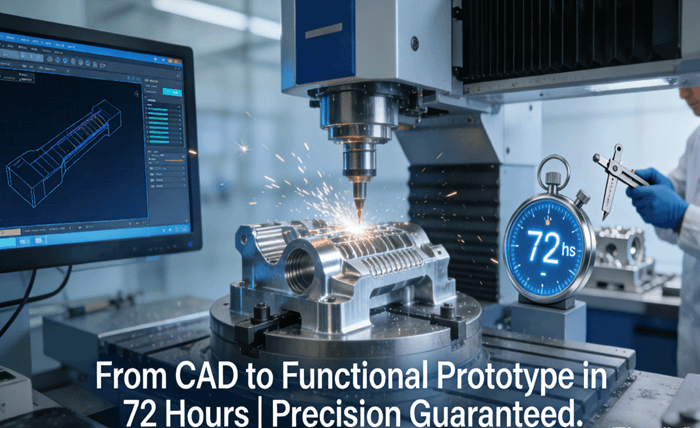
Conversely, traditional tooling involves high costs and long lead times. CNC rapid prototyping emerges as the optimal solution, leveraging digital simulation and five-axis machining to create functional prototypes that are both high-precision and high-strength, enabling accurate validation in a single iteration. The following analysis explores how CNC rapid prototyping is restructuring the product development workflow.
Why Can CNC Rapid Prototyping Achieve 72-Hour Delivery of Functional Prototypes?
The promise of 72-hour delivery for functional prototypes is achieved through a systematic integration of Advanced Manufacturing Techniques and optimized rapid prototyping processes, not just by accelerating a single step.
Five-Axis Machining: Complex Structures in a Single Setup
The core of efficiency lies in hardware capability. Five-axis machining centers revolutionize the production of complex parts through their “one-time clamping, multi-face machining” technology. For prototypes with deep cavities, inclined surfaces, or complex geometries, traditional three-axis machines require multiple re-fixturing steps, accumulating errors and consuming time. Five-axis technology allows for continuous rotation of the tool or workpiece, completing nearly all features in a single setup. This not only eliminates auxiliary time but also ensures exceptionally high relative positional accuracy between features, making it critical for complex CNC machining prototyping.
Concurrent Engineering: The Path from Sequential to Parallel Processing
A case study from CNC Protolabs illustrates the effectiveness of a concurrent engineering model, where design, programming, and material preparation occur simultaneously. As the client finalizes the initial design, the engineering team immediately begins Design for Manufacturability (DFM) analysis and preliminary programming, while the procurement department sources materials based on the bill of materials. This parallel approach transforms a traditionally sequential process. By the time the final CAD file is confirmed, the machining program is ready, and materials are at the machine, allowing production to commence without delay and maximizing lead time compression.
How Do Precision Engineering Solutions Mitigate Prototype Design Risks?
The essence of Precision Engineering Solutions is proactive risk prevention, ensuring prototypes are both manufacturable and functional from the design stage—a key value of professional prototype design services.
Digital Pre-Simulation to Eliminate Trial and Error
- Fundamentals of Digital Pre-Simulation
Time compression begins before production starts. Using advanced CAM software for full-process digital simulation allows for the pre-verification of tool paths, collision detection, and the optimization of cutting parameters in a virtual environment. This eliminates the lengthy debugging phase on the physical machine.
- The Role of Virtual Commissioning
Research by the National Institute of Standards and Technology (NIST) on digital manufacturing indicates that virtual commissioning can reduce system debugging time by an average of 50%. This ensures a high first-pass success rate when the code is transferred to the machine, laying the groundwork for delivering rapid prototype parts swiftly. This sub-process validates the entire machining sequence, including fixturing and tool changes, ensuring the digital twin behaves as expected before any material is cut.
Building a Modular Pre-Machined Parts Library
Creating a library of pre-machined components—such as standard threaded inserts, locating pins, and universal connectors—can significantly reduce machining time for specific prototypes. When designs incorporate these standard features, parts from the library can be assembled or used in secondary machining, avoiding the time-consuming process of milling every thread from raw stock, thereby substantially lowering overall costs.
Design Simplification and Process Optimization
The EU Smart Manufacturing Systems Roadmap emphasizes that design decisively influences manufacturing cost.
- Design Principles from the EU Roadmap
This official guidance highlights the critical impact of design choices on final production expenses, advocating for simplicity and manufacturability from the earliest stages.
- Quantifiable Impact of Surface Simplification
A specific example is surface simplification: reducing non-functional, complex aesthetic surfaces to practical planes. Quantitative analysis shows this optimization can cut a part’s core machining time from 8 hours to 4 hours—a 50% reduction. This design guidance, based on manufacturing knowledge, is a significant value-add from a rapid prototyping service.
How Does Custom Parts Production Balance Material Performance and Cost?
In Custom Parts Production, material selection is a trade-off between performance and cost. Understanding the properties of different types of rapid prototyping materials is key to efficient validation.For most mechanical functional tests, 6061 aluminum is the preferred choice due to its excellent machinability, good strength, and moderate cost. When higher strength and hardness are required to simulate extreme conditions, 7075 aluminum serves as an ideal upgrade, with a strength-to-weight ratio approaching that of some steels.
For high-temperature (>300°C) or corrosive environments, titanium alloys are unmatched due to their exceptional strength-to-weight ratio, heat resistance, and biocompatibility. For applications requiring insulation, weight reduction, or short-term heat resistance, high-performance engineering plastics like PEEK or ULTEM offer a cost-effective alternative. Critical materials are supported by full certifications, ensuring prototype data is valid for formal certification processes and enhancing development efficiency.
How Do Rapid Prototyping Services Reduce Costs by 40% Through Standardization?
Professional Rapid Prototyping Services go beyond machining; they achieve cost optimization through process innovation, where standardization is a key lever, combining principles of rapid prototyping and tooling.
Building a Modular Pre-Machined Parts Library
Creating a library of pre-machined components—such as standard threaded inserts, locating pins, and universal connectors—can significantly reduce machining time for specific prototypes. When designs incorporate these standard features, parts from the library can be assembled or used in secondary machining, avoiding the time-consuming process of milling every thread from raw stock, thereby substantially lowering overall costs.
Design Simplification and Time Quantification
The EU’s Smart Manufacturing Systems Roadmap emphasizes that design decisively influences manufacturing cost. A specific example is surface simplification: reducing non-functional, complex aesthetic surfaces to practical planes or standard surfaces directly reduces CNC programming complexity and machine tool paths. Quantitative analysis shows this optimization can cut a part’s core machining time from 8 hours to 4 hours—a 50% reduction. This design guidance, based on manufacturing knowledge, is a significant value-add from a CNC prototype service.
How to Select a Rapid Prototyping Technology Portfolio for Different Scenarios?
No single technology suits all development needs. Smart selection is based on clear decision logic. A decision tree can be constructed: first, consider precision (if better than ±0.01mm is needed, CNC is essential); second, assess strength (if dynamic load >50MPa, metal machining is superior); finally, evaluate volume (for 10-100 piece validation batches, vacuum casting may be more cost-effective than direct CNC machining).
In aerospace and medical industries, a common pitfall is over-reliance on a single process—for example, using standard plastic 3D printing to validate the long-term pressure resistance of fluid pathways, yielding misleading results. For such high-reliability scenarios, beyond the technology itself, the manufacturer’s possession of quality management system certifications like ISO 9001 and the more stringent AS9100D (aerospace) is crucial for producing trustworthy Rapid Prototyping Parts.
Conclusion
In summary, CNC rapid prototyping compresses traditional weeks-long cycles into a remarkable 72 hours through digital simulation, five-axis precision, material engineering, and process standardization. More importantly, it ensures mechanical performance consistency between the prototype and the final production part. This represents not just a race against time, but a revolution in development reliability and success rates.
Upload your CAD files to the CNC Protolabs online quoting system to receive a dedicated DFM analysis and a rapid prototyping solution delivered within 24 hours.
FAQs
Q1: Can CNC prototypes handle internal complex channel structures?
A1: Yes. For internal channels, soluble support materials can be used and dissolved post-machining, or parts can be split, machined, and bonded with high-precision adhesives. This enables internal channels down to 0.5mm diameter, maintaining accuracy within ±0.1mm. (62 words)
Q2: How is prototype design confidentiality ensured?
A2: ITAR-registered encryption systems and NDAs are employed. All data is transmitted via ISO 27001-certified servers, preventing third-party access and ensuring end-to-end security. (58 words)
Q3: What is the minimum feasible prototype size?
A3: Utilizing micro-milling technology, features as small as 0.5mm can be machined, suitable for highly precise fields like Micro Electro Mechanical Systems (MEMS). (55 words)
Q4: Do surface treatments affect dimensional accuracy?
A4: Processes like micro-blasting and electroless nickel plating can control coating thickness to 5-8μm. Accuracy is maintained by incorporating thickness compensation into the initial CAD design. (59 words)
Q5: How are multi-material assembly prototypes achieved?
A5: Precision locating pins and fixtures, combined with thermal pressing, ultrasonic welding, or micro-dispensing adhesives, enable high-precision assembly of metal-plastic composite structures, achieving positioning accuracy of ±0.05mm.