


Introduction
In today’s manufacturing landscape, engineers face prototype development cycles stretching 4-8 weeks and high tooling costs of $20,000-$50,000 for steel molds, slowing innovation and iteration. These challenges stem from rigid traditional methods that lack flexibility for small-batch production and often lead to design flaws requiring costly rework.
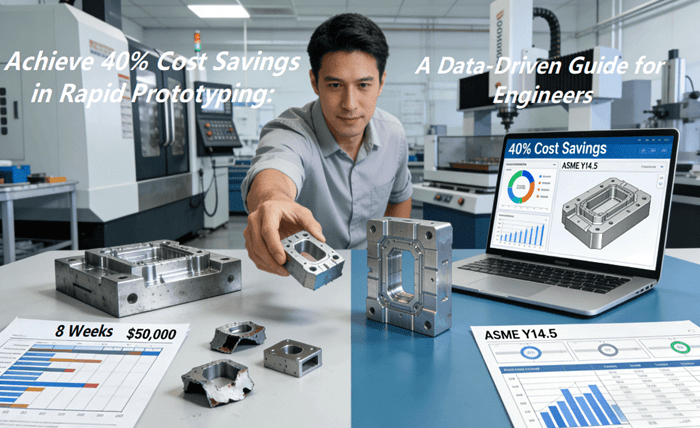
This guide introduces rapid prototyping strategies such as aluminum tooling and modular design, leveraging data-driven approaches to compress cycles to 2-3 weeks and reduce costs by 40-60%. Referencing standards like ASME Y14.5 ensures precision foundations. The following sections will dissect tooling selection, cost optimization, and real-world cases to help engineers achieve efficient prototyping.
What Are the Key Strategies for Selecting Cost-Effective Rapid Tooling Materials?
Choosing the right material is critical for balancing cost, durability, and application needs. A strategic comparison between options like aluminum and steel reveals significant savings opportunities.
1. Material Cost and Durability Analysis
Aluminum tooling costs 60% less than steel upfront, with durability reaching 50,000 cycles for engineering-grade resins like ABS or polycarbonate. The material savings extend beyond initial costs to include faster machining times and reduced energy consumption during production. For high-volume applications exceeding 100,000 cycles, pre-hardened steel tools provide better long-term value despite higher initial investment. This strategic selection process requires careful analysis of production volumes and material compatibility to maximize return on investment. The decision matrix should consider both technical requirements and business objectives to ensure optimal outcomes.
2. Application-Specific Performance
Aluminum’s superior thermal conductivity enables 20-30% faster cooling cycles compared to steel, significantly reducing production time for thermoplastic components. This characteristic makes it ideal for consumer electronics prototyping where rapid iteration is crucial. However, for applications involving abrasive composite materials like glass-filled nylons, steel’s wear resistance provides longer tool life and more consistent part quality. The material selection process must account for chemical compatibility, operational temperatures, and mechanical stress requirements. Engineering teams should conduct thorough testing under simulated production conditions to validate material performance before full-scale implementation.
3. Lifecycle Cost Considerations
Comprehensive cost analysis must extend beyond initial tooling investment to include maintenance, repair, and potential refurbishment costs over the tool’s lifespan. Aluminum tools typically show excellent cost-performance for production runs under 10,000 units, while steel becomes more economical for higher volumes. The analysis should factor in material degradation rates, planned production volumes, and potential design changes that might require tool modifications. Implementing a preventive maintenance schedule can extend tool life by 30-40% regardless of material choice. This holistic approach ensures accurate total cost of ownership calculations for informed decision-making.
How Can Bridge Tooling Accelerate Prototype to Production Transitions?
Bridge tooling serves as an intermediary step, validating designs before full-scale production. It mitigates risks and reduces time-to-market.
1. Risk Reduction Through Functional Validation
Bridge tooling methods like CNC-machined aluminum prototypes enable testing of 5,000+ functional units within 2-3 weeks, identifying issues early. For instance, a drone manufacturer used this to correct airflow inefficiencies, avoiding $50,000 in mold rework. By adopting rapid prototyping services, teams ensure a seamless transition to production, as detailed in industry guides.
2. Precision and Tolerance Management
Advanced metrology systems including laser scanners and coordinate measuring machines verify critical dimensions against CAD models with micron-level accuracy. The validation process ensures that all components meet specified geometric dimensioning and tolerancing requirements before production tooling begins. This phase typically identifies potential manufacturing issues related to draft angles, wall thickness variations, and other critical design elements. Implementing statistical process control methods during bridge tooling provides valuable data for optimizing production parameters. This data-driven approach minimizes variability and ensures consistent quality throughout the product lifecycle.
3. Cost and Time Efficiency
Bridge tooling implementation typically reduces overall development time by 4-6 weeks compared to traditional sequential approaches. The methodology enables parallel development of production tooling while validating designs through functional testing. This concurrent engineering approach provides substantial cost savings by eliminating the need for multiple prototype iterations and associated tooling modifications. The ability to produce market-validation quantities of 500-5,000 units allows for early customer feedback and regulatory testing while production tooling is being manufactured. This compressed timeline accelerates time-to-market while maintaining quality standards.
What Design Principles Ensure Fast Turnaround in Low-Volume Production?
Design for manufacturability (DFM) and modularity are key to speeding up low-volume runs while controlling costs.
- DFM Optimization for Efficiency: Systematic DFM analysis identifies potential manufacturing constraints early in the design process, preventing costly revisions during tooling development. This involves evaluating wall thickness uniformity, appropriate draft angles, and optimal gate locations for injection molding applications. Engineers should prioritize designs that minimize complex coring actions and side actions in molds, as these features significantly increase tooling complexity and cost. Implementing standardized component libraries for common features like ribs, bosses, and mounting points accelerates the design process. The DFM process should also consider material flow characteristics and cooling channel optimization to reduce cycle times.
- Modular Design for Flexibility: Modular tooling systems enable rapid configuration changes for different part variants without requiring complete tooling redesign. This approach uses standardized base plates and interchangeable inserts that can be quickly swapped to produce different components. The modular architecture supports family mold concepts where multiple related parts are produced from the same tooling base. This strategy significantly reduces tooling investment for product families with multiple variants or frequent design updates. The system’s flexibility allows for easy incorporation of engineering changes through insert replacement rather than full tool modification. This adaptability is particularly valuable in industries with short product lifecycles.
- Standardization and Its Impact: Comprehensive standardization of tooling components across product platforms generates substantial cost savings and reduces lead times. Using standard mold bases, ejector pins, and cooling connectors simplifies maintenance and reduces inventory requirements. This approach enables predictable costing and faster procurement since standard components are readily available from multiple suppliers. Implementing standardized design guidelines for features like radii, wall thickness, and draft angles ensures manufacturability across different production facilities. The standardization effort should extend to documentation formats and quality control procedures to maintain consistency throughout the product development process.
How Does On-Demand Manufacturing Balance Flexibility and Cost Control?
On-demand manufacturing leverages digital platforms to offer flexibility for small batches while maintaining cost predictability.
1. Cloud-Based Monitoring and Control
Digital manufacturing platforms provide real-time visibility into production status, quality metrics, and delivery schedules through centralized dashboards. These systems enable predictive analytics that forecast potential delays or quality issues before they impact production schedules. The platform’s algorithm continuously optimizes production scheduling based on real-time machine availability and material logistics. Customers can monitor order progress through customized portals that show completed operations, quality inspection results, and shipping status. This transparency enables better planning and inventory management throughout the supply chain, reducing carrying costs and improving cash flow.
2. Sustainability and Certification Advantages
ISO 14001-certified processes minimize waste, appealing to eco-conscious clients. A case saw a 15% energy reduction through optimized cycles, aligning with green manufacturing trends. For global access, rapid prototyping services in china offer agile solutions, as noted in industry resources.
3. Scalability for Growing Demands
On-demand production models seamlessly scale from prototype quantities to full production volumes without requiring tooling changes or process requalification. The system maintains consistent quality standards through automated process controls and real-time monitoring regardless of order size. This scalability is particularly valuable for products with uncertain demand patterns or seasonal fluctuations. The flexible manufacturing approach allows for economical production of small batches while maintaining the capability to rapidly increase volumes when needed. This adaptability reduces financial risk associated with inventory buildup and enables more responsive supply chain management.
What Are Common Pitfalls to Avoid When Reducing Tooling Costs?
Avoiding common errors in tooling design and material choice is crucial to achieving savings without compromising quality.
- Neglecting Thermal Management: Inadequate cooling system design remains one of the most frequent and costly errors in tooling development. Proper thermal management requires strategic placement of cooling channels that follow the tool’s geometry to ensure uniform heat extraction. Advanced simulation software can model heat distribution during the molding process to identify potential hot spots that could cause warping or extended cycle times. Implementing conformal cooling channels that match the tool’s contour can reduce cycle times by 20-30% while improving part quality. The cooling system design should balance initial investment against long-term production efficiency and part quality requirements.
- Overlooking Standardization: Excessive customization of tooling components creates unnecessary complexity and increases both initial cost and long-term maintenance requirements. Standardized components are readily available, cost-effective, and supported by established maintenance procedures. The lack of standardization often leads to extended lead times for custom components and limited supplier options. This approach also complicates documentation control and increases training requirements for maintenance personnel. Implementing a modular design philosophy with standardized interfaces provides the flexibility needed for product variations while maintaining the benefits of standardization.
- Ignoring DFM Feedback: Failure to incorporate DFM recommendations during the design phase often results in manufacturability issues that require expensive tooling modifications. Early collaboration between design and manufacturing engineers ensures that design intent is maintained while optimizing for production efficiency. The DFM process should address material selection, wall thickness consistency, and appropriate draft angles for the chosen manufacturing process. Regular design reviews with cross-functional teams help identify potential issues before tooling fabrication begins. This proactive approach prevents costly revisions and delays during the critical tooling development phase.
How Can Innovative Technologies Like 3D Printing Enhance Rapid Prototyping?
Additive manufacturing introduces new possibilities for complexity, speed, and material diversity in prototyping.
1. Geometric Freedom and Precision
Advanced additive manufacturing technologies enable production of complex internal channels, lattice structures, and organic shapes that are impossible with traditional manufacturing methods. The layer-by-layer construction process eliminates the geometric constraints of tool access and draft angles inherent in subtractive methods. Modern industrial 3D printers achieve resolution down to 20 microns, producing parts with excellent surface finish and dimensional accuracy. This capability is particularly valuable for components with integrated cooling channels or lightweight structures that require optimal material distribution. The technology enables consolidation of multiple components into single pieces, reducing assembly operations and improving reliability.
2. Material Versatility and Applications
Contemporary additive manufacturing systems process an extensive range of materials including engineering-grade thermoplastics, metals, ceramics, and composite materials. Each material category offers specific mechanical, thermal, and chemical properties suitable for different application requirements. The technology enables production of functional prototypes that accurately simulate the performance of final production parts. This capability is crucial for validation testing under real-world conditions before committing to production tooling. The material selection continues to expand with advanced composites offering properties tailored for specific industries including aerospace, medical, and automotive applications.
3. Surface Finish and Post-Processing
Sophisticated post-processing techniques have evolved to address surface quality requirements for additive manufactured components. These include chemical vapor smoothing, centrifugal finishing, and automated support removal systems that ensure consistent results. The post-processing workflow is increasingly integrated with the printing process through automated handling systems that minimize manual intervention. Different finishing methods achieve specific surface characteristics from textured functional surfaces to high-gloss aesthetic finishes. The selection of appropriate post-processing methods depends on the application requirements, material characteristics, and quality standards for the final component.
Conclusion
Rapid prototyping tooling, through material innovation, modular design, and digital integration, can slash costs by 40% and cycles to weeks, complying with ASME and ISO standards. Data-driven strategies empower engineers to iterate faster, fostering innovation and competitiveness.
FAQs
Q1: What is the typical lead time for rapid prototyping services?
A: With methods like aluminum tooling, lead times can be as short as 3 days for prototypes. Automated processes and ISO 9001 checks ensure speed without sacrificing precision.
Q2: How does bridge tooling reduce risks in product development?
A: It allows validation using production materials before steel molds, enabling tests of up to 5,000 units in 2-3 weeks. This early issue identification can save $50,000 in rework.
Q3: What materials are best for low-volume production tooling?
A: Aluminum alloys suit volumes under 10,000, offering cost-effectiveness and 50,000-cycle durability. For abrasive materials, H13 steel is recommended, per ASME Y14.5.
Q4: Can rapid prototyping services handle complex geometries?
A: Yes, 5-axis CNC machining supports geometries with ±0.02mm tolerances. Technologies like conformal cooling enhance accuracy for sectors like aerospace.
Q5: How do I ensure quality in on-demand manufacturing?
A: Partner with certified suppliers (e.g., ISO 14001, IATF 16949) who use CMM scanning and real-time monitoring. This maintains Cpk ≥1.67 for consistency.