


There is poetry in the English language. It’s musical. And the present continuous tense is a tense that can convey that poetry. When you form an affirmative sentence in this tense, not only are you informing us of what is happening — you’re painting a picture of life unfolding at this very moment.
In this lesson, we are going to learn the meaning, structure, functions, examples, and even a few things not to do when employing present continuous affirmative sentences. Take it for a grammar lesson and a gentle nudge towards more confidence with English.
What Are Present Continuous Affirmative Sentences?

Let’s do the simple one first. You have a camera. You click the button. The picture stops moving. That is what the present continuous does — it stops something happening.
A present continuous affirmative sentence is a sentence that tells us about something happening at the moment, or about now.
Examples
- I am writing a blog post.
- She is cooking dinner.
- They are playing football in the yard.
Each sentence verifies reality. No denial. No doubt. Just life in action.
The Formula of Present Continuous Affirmative Sentences
Your structure is your power. Without it, the building falls.
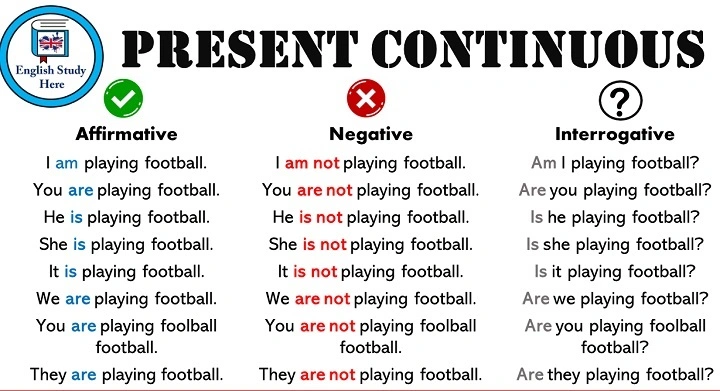
Formula: Subject + am/is/are + verb(-ing) + object/complement
Examples
- I am learning English.
- He is repairing the car.
- We are studying together.
It looks easy. And so it is. But within this structure exists a strong capacity to describe moments, feelings, and ongoing action.
Why Do We Use Present Continuous?
Ask yourself: why can’t we simply say “She cooks dinner”? Why overcomplicate it?
Because the present continuous tense creates an image. It brings it to life. It shows movement. It makes the listener sit up and construct the picture with you.
We use it for:
Things Done At The Moment
- She is listening to music.
- I am typing on my laptop.
Activities happening in the near future
- I am going to visit my cousin’s house this week.
- He is working at home today.
Future Plans
- We are going to see our teacher tomorrow.
- She is leaving next weekend.
Constant Changes and Trends
- Increasingly more people are studying English on the internet.
- The weather is warming up every year.
The tense is dynamic. It makes one value the fact that nothing remains constant.
The Role of “Be” in Present Continuous
This is where most students err. They do recall the little helper — the verb “to be.” But in reality, am/is/are is the hinge. Remove it and the sentence breaks down.
- I am reading.
- She is speaking.
- They are sprinting.
Remove “am/is/are,” and what you are left with sounds defective:
❌ I reading.
✔ I am reading.
So keep your helper close.
The Magic of “-ing”
The “-ing” is no rule. It’s a rhythm. It stretches the verb like an elastic band, signaling continuity.
- Run → running
- Eat → eating
- Play → playing
Some changes take place:
- Write → writing (drop the “e”)
- Swim → swimming (double the consonant)
The “-ing” suggests the action is alive, in the present, breathing.
Antonym of Simple Present

Break here. Simple present and present continuous get mixed up by most students.
- Simple Present: She works at a hospital. (fact, habit)
- Present Continuous: She is working at a hospital this month. (temporary, on-going)
The simple present is the sun rising every morning. The present continuous is the passing cloud this moment.
Examples That Make It Real
Lists can be effective. These are some good present continuous sentences:
- I am learning new words.
- She is walking to school.
- We are watching a movie together.
- He is repairing his old bicycle.
- They are placing flowers in the garden.
- You are getting better and better every day.
Each sentence is good. Each one places the action in the “now.”
Common Mistakes to Avoid
We learn from errors. But what’s the point of repeating the same if we can learn something?
Leaving out “am/is/are”
- Wrong: They playing outside.
- Right: They are playing outside.
Getting it confused with Simple Present
- Wrong: She dance now.
- Right: She is dancing now.
Abusing Stative Verbs
- Wrong: I am knowing the answer.
- Right: I know the answer.
How to Practice Every Day
Mastering grammar is watering a plant. A little bit each day makes it grow.
Some things you can do:
- Speak things out loud: “I am brushing my teeth. I am reading the news.”
- Keep a short diary: 3–4 sentences per day about what you are doing.
- Use pictures: Tell a picture and speak what people are doing.
- Record yourself: Play it back. Listen. Re-write.
The aim is fluency, not perfection.
Exercises for You
Try them. Fill them in the correct form.
- (I / cook / dinner) → ____________________
- (She / read / a book) → ____________________
- (They / play / guitar) → ____________________
- (We / travel / to London) → ____________________
- (He / watch / TV) → ____________________
Now, read them out. Catch the rhythm.
Deeper Use in Conversations

Advanced speakers also make use of this tense.
Compare:
- Simple: He works hard.
- Continuous: He is working very hard this week on his new project.
The second kind breathes. It gives context. It tells the listener that the action is there, passing, and has meaning.
Emotional Power of the Tense
Think about this: when you say, “I am waiting for you,” it counts. It’s not grammar. It’s feeling. It’s urgency. It’s love, longing, or frustration.
Present continuous isn’t about rules. It’s about connecting with people now.
Quick Recap
- Formula: Subject + am/is/are + verb(-ing).
- Use: Now, temporary actions, future plans, trends.
- Watch out: Never leave out the “be.” Don’t use stative verbs.
- Practice: Speak, write, listen.
FAQs on Present Continuous Affirmative Sentences
What is a present continuous affirmative sentence?
It’s a positive statement showing an action is happening now, using am/is/are + verb(-ing).
Can present continuous be used to talk about the future?
Yes. To talk about plans, i.e., “We are meeting tomorrow.”
Which verbs cannot be used with the present continuous?
Stative verbs like know, love, believe, and understand.
How can I avoid mistakes with this tense?
Always insert “am/is/are,” use the “-ing” form, and drill with everyday tasks.
Is present continuous used in formal writing?
Yes, but particularly in speech. Written form is used to indicate present or momentary action.
Conclusion: Living in the “Now”
Present continuous positive sentences are attractive because they take hold of the moment. Life doesn’t stand still. Language shouldn’t either. With every “I am learning,” or “She is smiling,” we marry the moment and language.
See it through. Keep listening. Before long, you won’t be learning English — you’ll be living it, moment by moment, sentence by sentence.